
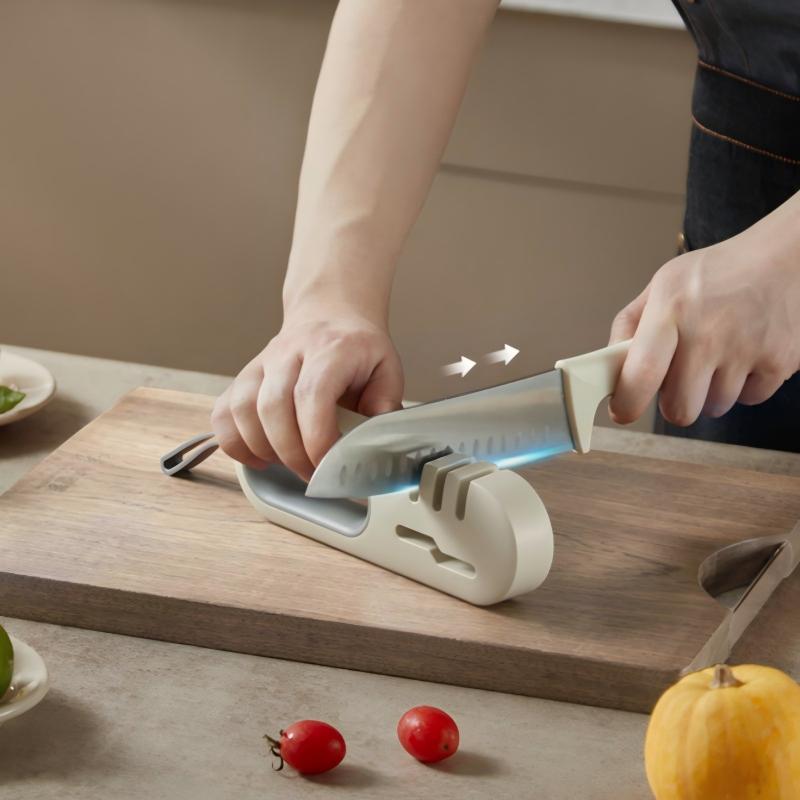
Sharpening stone
Core value: The sharpness of the origin and the transmission of skills
Source of effectiveness: It converts the loss of friction into the regeneration of the blade edge, and is the cornerstone for maintaining the basic performance of all cutting tools (kitchen knives, scissors, chisels, plane knives).
The carrier of skills: The polishing process is a profound dialogue between the user and the tool, requiring precise control of angles, force and rhythm. It is the cultivation of the artisan’s “touch” and “eye”.
Economy and Sustainability: Making expensive tools last for decades is the practical application of the “repairing is caring” sustainable living philosophy.
Using the Mindset: Angle, Pressure and Rhythm
Core Triangle:
Angle: Maintaining a constant angle between the blade and the stone surface (typically 15-20 degrees for household kitchen knives) is crucial for success. An angle guide can be used for assistance.
Pressure: Push forward with a gentle pressure, pull back with a light touch. For rough grinding, a moderate force can be applied; for fine grinding, it should be done with extreme gentleness.
Rhythm: Uniform and stable, forming muscle memory.
Standard Procedure:
Preparation: Soak the stone in water until no bubbles appear.
Grinding: Sprinkle water on the stone surface, then push and pull it at a fixed angle back and forth until the blade completely adheres to the stone surface, creating uniform “grinding marks”.
De-burring: After one side is polished, “sharp edges” will form. These need to be removed from the other side using a lighter pressure or a stone with a higher grit number.
Fine grinding and polishing: Repeat with higher-numbered stones until the edge becomes smooth.
Cleaning and Testing: Wash the knife, then test its sharpness by cutting paper and peeling tomato skins.
Scene and Philosophy
Kitchen: Regular maintenance to make chopping vegetables a pleasure rather than a strenuous task.
Workshop: Essential tools for carpenters, leather workers, and gardening enthusiasts, ensuring the tools are always in top condition.
Self-cultivation and self-improvement: Grinding is an excellent exercise for concentration. The process itself is a form of meditation. Listening to the rhythmic sound of the friction, watching the sharp edge gradually emerging, the mind also becomes calm.
Important Note:
Flatness is the foundation: The grinding stone itself must remain flat. After long-term use, the surface of the stone may become concave, and it needs to be smoothed out using a stone smoothing tool or by grinding it on a rough cement surface.
Lubrication is crucial: Water or oil can remove the debris, prevent the stone holes from getting clogged, and ensure the grinding efficiency.
Safety first: Both the sharp blade itself and the flying abrasive particles must be protected against.
Summary: The essence of the whetstone
It is a “systematic sacrifice” – through the shedding of the stone’s own particles, it removes the metal and reshapes the edge. It does not create sharpness; instead, it releases the sharpness that lies hidden within the dull edge.
It teaches us:
The sharpest edge comes from the most patient grinding.
To maintain excellence, regular review and correction are necessary.
The vitality of a tool lies in the continuous and focused interaction between the user and the object.
Ultimately, a good sharpening stone is like a silent and strict teacher. It not only teaches you how to make the knife sharper, but also instills in you a serious attitude towards tools, work and life.