
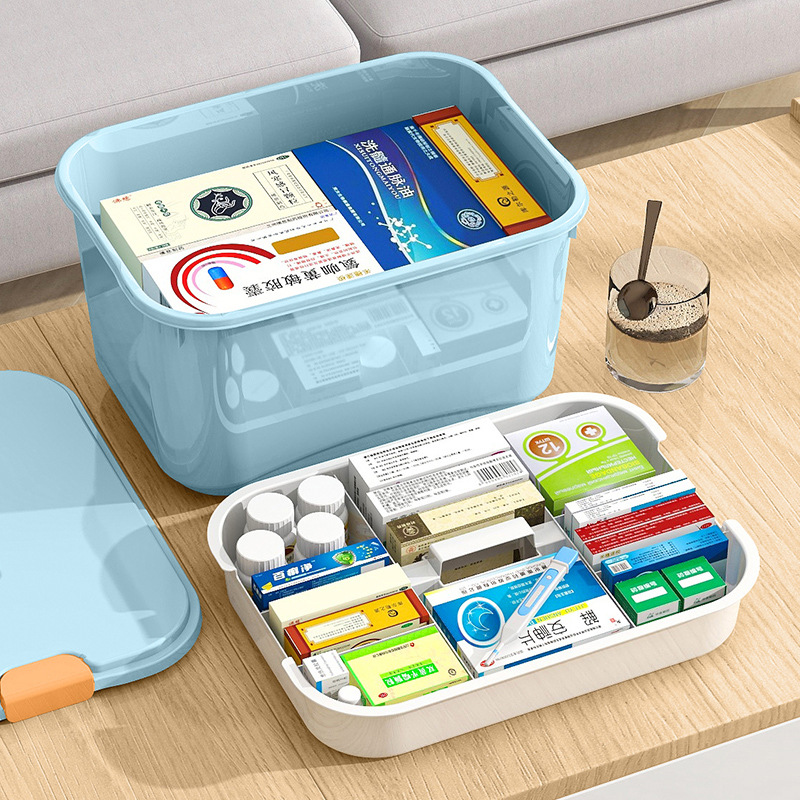
First aid kit
Core positioning: The first line of defense in health management
Physical basis of emergency response: Whether the correct medicines and tools can be found within 3 minutes in case of accidental injury or sudden discomfort directly affects the handling outcome. The medicine box consolidates scattered items to achieve “targeted positioning”.
Systematic health management: It forces us to categorize, archive and conduct regular checks on medications, avoiding the chaos and risks associated with “not being able to find what is needed when needed” and “using expired medications”.
A symbol of safety and responsibility: A neatly organized medicine cabinet reflects the family manager’s orderly care and scientific attitude towards the health of family members.
Key considerations for choosing a first aid kit
Material and structure:
Hard plastic/metal > Soft cloth bags. Hard boxes can better protect medicines from being squeezed, getting damp and being contaminated.
Sealing performance: A good sealing strip can prevent moisture and dust, and is particularly crucial for areas in the south with high humidity.
Partition design: Built-in partitions, elastic bands, and small compartments, facilitating the classification and fixation of medicines to prevent them from becoming mixed together.
Size and Portability:
Household main medicine box: It is recommended to choose a capacity of 20-30 liters, which is sufficient to store all the items and should be fixedly placed in a dry and cool place (avoid bathrooms and kitchens).
Travel/Cargo Vehicle First Aid Kit: Opt for a compact and portable model, equipped with essential trauma care supplies and a few medications for alleviating symptoms.
Security Design:
Child safety lock: For families with children, it is necessary to choose a medicine box with a lock or one that is difficult for children to open.
Clear identification: The box should have a prominent red cross or the word “Emergency” for easy identification in case of an emergency.
Management and Maintenance: What is more important than ownership is maintenance.
Fixed Location: The entire family should be clearly aware of the sole fixed storage location of the medicine box.
List and Record: A list of items and an expiration schedule are provided either inside or outside the box. Check them every 3-6 months and discard any expired or deteriorated medicines promptly.
Pharmaceutical Management:
Store in original packaging: Keep together with the instruction manual for easy information verification.
Refuse “drug guessing”: For unidentifiable drugs, they should be discarded without hesitation.
Temperature-sensitive: Some medicines require refrigeration and should not be placed in the main medicine container.
Knowledge reserve: Place a family first aid manual in or near the medicine box, and follow the instructions when in a critical situation.
Its philosophy: A philosophy of being prepared for any eventuality
The existence of the medicine cabinet is not to wait for illness, but to be able to calmly, scientifically and quickly restore peace when there are minor fluctuations in health. It represents:
Rational plans for uncertainty, tangible care for family members, and the modern practice of “prevention is better than treatment” based on this ancient wisdom.
Ultimately, a well-prepared and well-maintained first aid kit is an important part of a family’s sense of security. It stands silently in the corner, yet loudly declares: This home has made the most basic and also the most crucial preparations for safeguarding the health of its members.