
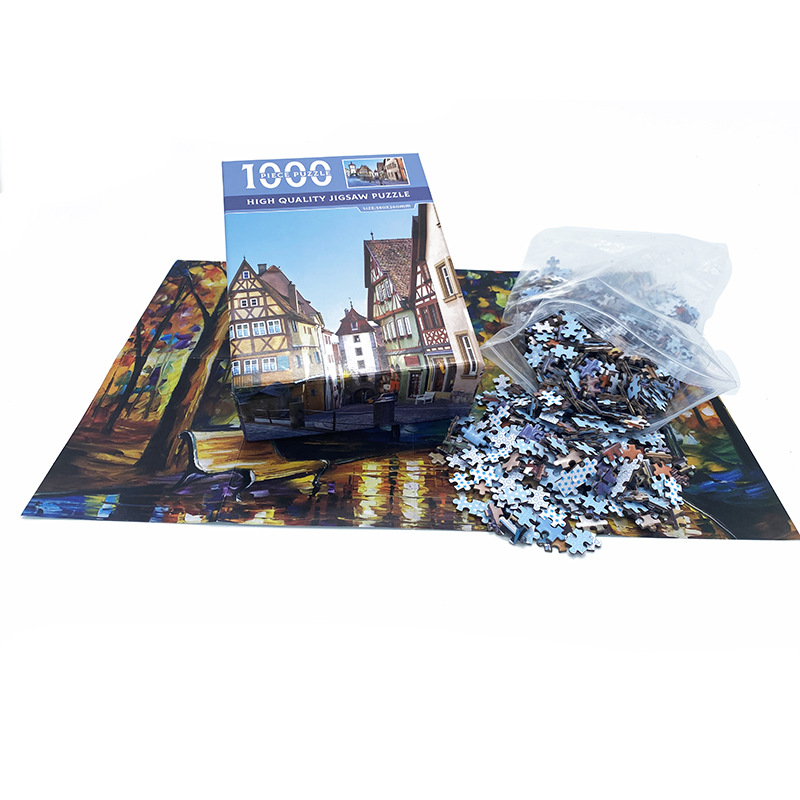
Boxed 1000-piece challenging jigsaw puzzle
I. Core Value: A Multi-Dimensional Mental Exercise
Deep Concentration and Flow Experience:
It forcibly pulls you into a world without digital distractions, requiring hours of intense concentration. It is an excellent way to treat fragmented attention and enter the “flow” state.
The ability to solve problems systematically:
In the face of thousands of uncertainties, you must establish a systematic approach involving identification, classification, hypothesis formulation, trial and error, and verification. You also need to develop your logical thinking and project management skills.
Delaying gratification and the cultivation of resilience:
Completing it will take several days or even weeks. It is a micro-practice of maintaining long-term goals. Every small success (correcting one area) is accumulating towards the ultimate sense of achievement.
Art appreciation and detailed observation:
Highly challenging jigsaw puzzles often feature famous paintings, maps, microscopic worlds, or other subjects with extremely detailed elements, subtle color gradations, or numerous repetitive patterns. This forces you to appreciate the art from a “pixel-level” perspective, uncovering details that were previously unseen.
II. “Typical Characteristics of High Difficulty” (Selection and Challenge Precautions)
Complexity of patterns:
Monochrome/Gradation: Such as a pure blue sky, a gradual transition of the setting sun, with no distinct boundaries.
A large number of repetitive elements: such as densely arranged English letters, similar leaves in a forest, and similar brick walls of a castle.
Detail explosion: Works such as Bosch’s “Paradise on Earth” and Bruegel’s “Netherlandish Proverbs” are filled with independent narratives.
Piece assembly design:
Special-shaped pieces: Not in the standard “four convex and four concave” configuration, which increases the uncertainty in assembly.
Uniform cutting: All the pieces have extremely similar shapes, making it difficult to filter them based on shape.
Lack of references: Some abstract art pieces or puzzles with specific themes cannot be solved through common sense reasoning.
III. Professional Strategy: Systemic Method for Conquering the Thousand-Piece Puzzle
Preparation Phase: Establish the “Command Center”
Space: Ensure there is a large and flat surface that can be occupied for an extended period, such as a table or a jigsaw puzzle board.
Tools: Shredding discs/boxes (essential for sorting), jigsaw puzzle mats (can be rolled up to preserve progress), small tweezers (for handling delicate parts).
Core process: Four-step stratification method
Step 1: Screening and Classification
Find all the border pieces and assemble them to form the outer frame.
Classify them into primary categories based on color, pattern and special texture.
Separate out those with distinct features (such as faces, text, unique objects).
Step 2: Establish the “bridgehead”
Start by identifying the most recognizable and distinctive area in the pattern, and establish several scattered small outposts. This will provide a continuous positive feedback.
Step 3:攻坚与连接
When dealing with large areas of gradual changes or repetitive regions, a secondary classification based on the shape of the puzzle is required.
Use the “trial and error method”, but with a strategy: first, match based on the color and the shape of the gap in the adjacent already assembled part.
Step 4: The Final Battle
The remaining pieces are often the ones with the most ambiguous colors and shapes. At this point, a great deal of patience is required. One needs to repeatedly compare them or use the “exhaustive method” to try each option one by one.
Mental State Management:
Allow for pauses: When encountering a bottleneck, take a break and come back later. You may often make new discoveries.
Enjoy the process: Consider each “click” sound that fits together as a reward.
IV. After Completion: The Continuation of Achievements
Frame and Display: Use puzzle glue to fix it and frame it as a painting. This is a tangible symbol of your mental effort, with great decorative value.
Socializing and Sharing: Share your experiences and achievements on social platforms, join puzzle communities, and exchange skills and insights.
Rounds and Challenges: You can exchange with others, or challenge for more episodes or more difficult themes.
V. Its Philosophical Metaphor
These 1,000 pieces of the puzzle are like a miniature version of a life project:
The goal is grand (in a complete picture) but the start is chaotic (a pile of fragments).
Methodology is more important than brute force (systematic classification).
The progress is non-linear (sometimes rapid, sometimes stagnant).
Persistence always has its echo (the completeness at the final moment of integration).
It quietly tells you: Any complex chaos can be reorganized into a complete and beautiful work through patience, methods and a series of small actions.
Ultimately, completing a 1000-piece challenging jigsaw puzzle brings you not just a picture, but also an absolute sense of confidence in your concentration, strategy and character. It is a long game with yourself, and you have won.