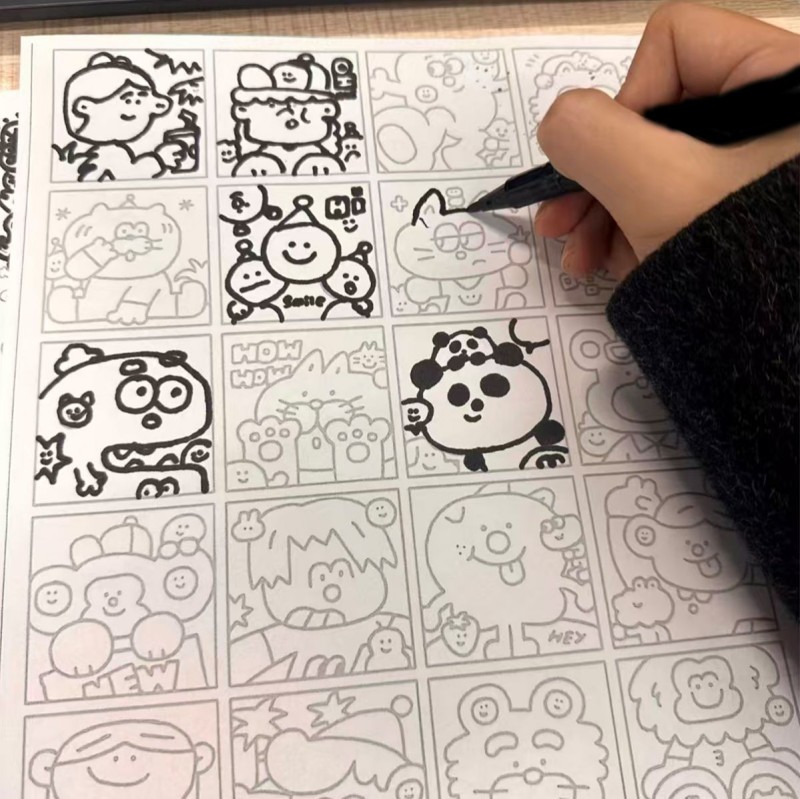
A4 sketch copy drawing
I. Core Value: Zero-barrier Confidence Builder
Eliminate the “Blank Page Fear”:
The anxiety of staring at an empty canvas was alleviated by the pre-set, faint guiding lines. It told you: “Start from here and follow me.”
Muscle memory training:
Through repeated practice, the hands form a “memory” of specific lines, shapes and proportions, which is the most efficient way to acquire solid basic skills.
Positive feedback loop:
Even with no prior experience, one can create a decent piece of work within a short period of time, achieving immediate satisfaction and being motivated to keep practicing.
II. Product Form and Design Highlights
Paper Characteristics:
Material: Mostly made of sulfuric paper, semi-transparent matte paper or Monken paper. The texture is tough, the transparency is moderate, and it is resistant to repeated wiping.
Weight: Usually ranging from 70g to 120g, it is just right to be firm and suitable for drawing, without being too thick to affect light transmission.
Content Design:
Step-by-step guidance: Classic design involves breaking down a complete pattern into 3 to 6 steps, gradually adding details from basic geometric shapes.
Rich in themes: covering animals, plants, characters, food, landscapes, cartoon IPs, Chinese traditional elements, journal borders, etc., meeting the needs of various interests.
Difficulty level classification: From simple large-scale graphics to detailed complex patterns, forming a learning ladder.
Humanized details:
Binding method: Loose-leaf binding or single sheets with separate pages, making it convenient to tear off for use or store.
Auxiliary grid: Some drawings will come with light-colored coordinate grids to assist in understanding the composition and proportions.
Backside blank space: Provides room for independent practice and creative expression.
III. Comprehensive Application Scenarios: Beyond Learning to Draw
Children’s Art Education Initiation:
Developing observation skills, hand-eye coordination and concentration is an excellent way to engage in parent-child painting.
Adult Stress Relief and Art Therapy:
Following the guidance of the lines and concentrating fully on the drawing is an effective way of mindfulness meditation.
Design inspiration and scrapbook material library:
Designers and enthusiasts of scrapbooking can quickly obtain the necessary materials. By following the process of copying – transforming – and re-creating, they can build their own image library.
Special education assistance:
For those who require fine motor skill training or who express themselves through painting, structured support is provided.
Gifts and Activities:
The DIY cards included as a gift, or the materials for the ice-breaking games in group activities.
IV. Utilizing Mind Techniques and Advanced Paths
Basic Stage (Pure Copying):
Place the drawing under a regular A4 sheet of paper and simply copy it. Focus on experiencing the smoothness of the lines and the simplicity of the shapes.
Observation Phase (Half-Imitation):
Study the blueprint carefully, then draw it in the blank space beside it from memory, and then compare and correct it to train your observation skills.
Creation stage (Transformation and Combination):
After becoming proficient, you can try to modify the expressions, dynamics of the patterns, or split their elements and combine them with other patterns to create new images.
Tool combination:
Pencil/Automatic pencil: Used for sketching and practice.
Pipette pen / Elegant pen: Used for drawing clear lines to complete the work.
Colored pencils / Markers: Used for coloring and adding depth.
V. The Philosophy Behind It: Simplification and Accessibility
It represents the democratization of “beauty” and “skills” – breaking down seemingly talent-dependent art forms into steps that anyone can master through practice. It emphasizes:
What matters is not having the talent to draw from birth, but having the courage to start and a continuous path to follow.
In summary, the A4 sketch copy drawing is an “invitation letter” and “map” leading to the world of creativity. It invites everyone who has a dream of painting but dares not put pen to paper with the lowest cost and the highest friendliness, saying: “Come on, the first stroke, I have already drawn it for you.”