
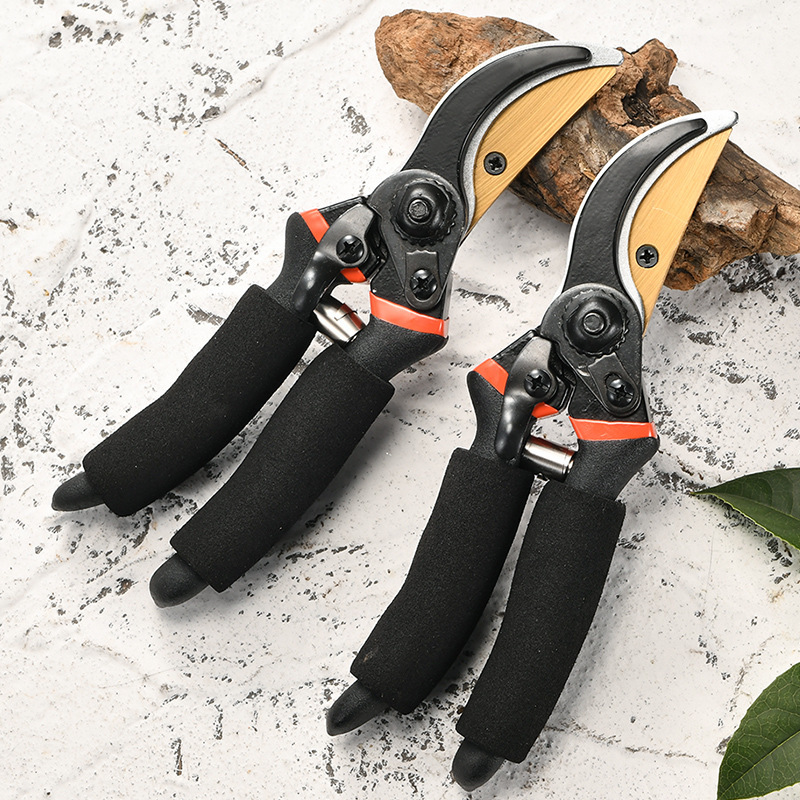
Fruit tree pruning shears
Core Mission: Scientific Trimming, Artistic Shaping
Health Management:
Remove diseased branches, dead branches and infested branches to prevent the spread of diseases and pests, improve the ventilation and light penetration within the tree canopy, and reduce the occurrence of diseases.
Remove overly dense branches, crossing branches and overgrown branches, concentrate nutrient supply on the fruiting branches, promote flower bud differentiation, and improve fruit quality and size.
Tree shape shaping:
According to the type of fruit trees (trees or shrubs) and the cultivation purpose (for ornamental purposes or for high yield), the growth direction of the trees is guided through pruning, and a stable, beautiful and convenient-to-harvest tree shape structure is constructed.
Life cycle regulation:
Perform shaping pruning on young trees, maintenance pruning on mature trees, and rejuvenation and strengthening pruning on old trees, thereby extending the economic lifespan of the fruit trees.
Applying the mind techniques and pruning principles
“Precision like a surgical operation”:
Position: Trim the outer side of the branch ridge that is close to the stem or mother branch. Do not leave any stubs and do not make the cut too deep to damage the mother branch.
Angle: The cut edge forms a 45-degree inclined surface, which facilitates the drainage of rainwater and prevents water from accumulating and causing rot.
Sequence: First, remove the large branches (diseased, dead branches, and crossing branches), then trim the smaller branches, and finally shape the tree.
Timing is everything:
Winter dormancy period (from after leaf fall to before bud break): Conduct shaping and pruning, remove branches, and make short cuts. At this time, the tree’s nutrients flow back, the impact of wounds is minimal, and the tree crown structure is clear.
Summer growth period: Remove suckers, pinch back shoots, prune excessive growth branches, regulate nutrients, and improve light conditions.
The maintenance of tools is the guarantee of efficacy:
After each use: Clean off the resin and dust to prevent corrosion.
Regular sharpening: Maintain the blade extremely sharp. A dull blade will tear the bark, causing wounds that are difficult to heal.
Apply oil at the activity point: Ensure smooth opening and closing.
Long-term storage: After cleaning, apply oil for rust prevention and store in a dry place.
The underlying gardening philosophy
A good pruning shears exemplify the balance between “intervention” and “respect”. Pruning is not random cutting; it is a guided intervention based on a profound understanding of the growth patterns of plants.
It teaches us that true cultivation sometimes requires the deliberate “abandonment” to achieve a more abundant “acquisition”; and the most meticulous care is often embodied in the most restrained and precise pruning.
In summary, the pruning shears for fruit trees are an extension of the gardener’s hand, a combination of wisdom and strength. Every neat and precise cut they make is like a love letter to the fruit trees, expressing their hope for a bountiful and healthy future.